
3.5 Boosting finding gaps in your SMS and GDC
Every effective SMS must cover all operational hazards, regulatory requirements, and good safety practices. However, gaps often exist— especially in areas where legislation does not explicitly prescribe actions.
What Is a ‘gap’ in Your SMS?
A gap refers to any area where:–
- A hazard is present but not properly managed.
- There is no clear procedure or training in place.
- No specific code or standard addresses the situation
Identifying and addressing these gaps proactively helps:
- Reduce legal liability.
- Prevent injuries and property damage.
- Improve overall safety performance and qualit
Gap = Opportunity for Improvement
Control the Drifts (leaks) in your Safety Management Systems

The Role of the General Duty Clause (GDC)
When legislation doesn’t specify how to control a hazard, the General Duty Clause (GDC) becomes the employer’s legal obligation to ensure the workplace is safe and risks are As low as Reasonably Practicable (ALARP)

Why the GDC Is Essential in Gap Analysis
- It applies where no regulation or standard exists.
- It serves as a catch-all safety requirement.
- It underpins court decisions and prosecution outcomes.
Key Message: The GDC must be included in your SMS gap analysis to cover the unregulated risks that can lead to catastrophic incidents.
Examples of GDC Application:
- Fatigue management where no formal policy exists.
- Mental health and psychosocial hazards.
- Equipment modifications without updated SOPs.
- not updating Fire safety plans.
- Duty of Care for Contractors
- Duty od care for the public and Volunteers

Next Step: Analyze Your GDC-Inclusive SMS
Use the tool for a “Free” SMS & GDC Gap Analysis to:
- Evaluate where your SMS lacks full coverage.
- Include GDC to demonstrate Due Diligence and reasonable care.
- Improve the robustness of your safety program.
Summary
- Every SMS has gaps — especially in non-prescribed areas.
- The General Duty Clause ensures those gaps are still covered by law.
- Your gap analysis should always include the GDC.
Organizations can develop their own OHSMS and apply for CPO accreditation, or adopt one of the recognized standards directly.
Brief summary of the accredited standards recognized by the CPO—ISO 45001, CSA Z45001, COR 2020—as equivalent accreditation options or alternatives to self-developed systems
Ontario MOL SMS accreditation standard
The Ministry of Labor, Immigration, Training and Skills Development (MLITSD) offers an accreditation standard through the Chief Prevention Officer (CPO) to recognize organizations with effective Occupational Health and Safety Management Systems (OHSMS).

MOL SMS acceptance criteria – https://www.ontario.ca/page/chief-prevention-officers-occupational-health-and-safety-management-system-accreditation-standard
Why It Matters:
Ontario is raising the bar by introducing formal accreditation for Health and Safety Excellence Programs (HSEPs), encouraging organizations to go beyond compliance.
Key Accreditation Elements:Organizations must show their SMS includes these components:
- Leadership & Participation
- Senior leadership commitment to health and safety
- Clear assignment of safety responsibilities and authority
- Worker participation and two-way communication
- Planning & Implementation
- Hazard identification and risk assessment processes
- Defined objectives and safety targets
- Training, competency, and controls for managing risks
- Contractor and third-party integration
- Evaluation & Continuous Improvement
- Internal audits and performance reviews
- Corrective action plans
- Management review meetings
- Documented plans for improvement
- Emergency Preparedness
- Site-specific emergency procedures
- Response training and drills
- Regular updates based on lessons learned
- Compliance with Existing Standards Organizations may already qualify for accreditation if using:
- ISO 45001:2018
- CSA Z45001-19
- BS OHSAS 18001:2007
- COR™ 2020 (IHSA)
- Responsible Care® RC14001 or RCMS
How boostingwithai.com helps
Our AI-driven SMS review tool can:
- Evaluate your current SMS against CPO accreditation criteria
- Highlight missing components or weak areas and gaps
- Recommend improvements based on best practices and regulations
- Assist in preparing for CPO Employer Recognition or third-party audits

Mr Bell was a key member on the Centrica safety case team and led on putting together the scope of the SMS to detail the safety policy, responsibilities and systems as shown on the chart below showing the inter relationship between depts. Mr Bell is an advocate for developing your own SMS to keep expertise in house and to coordinate staff on the specific EHS requirements of your organization.
Consider standards to support your SMS like CSA Z1000 or ISO 45001 too reinforce your brand
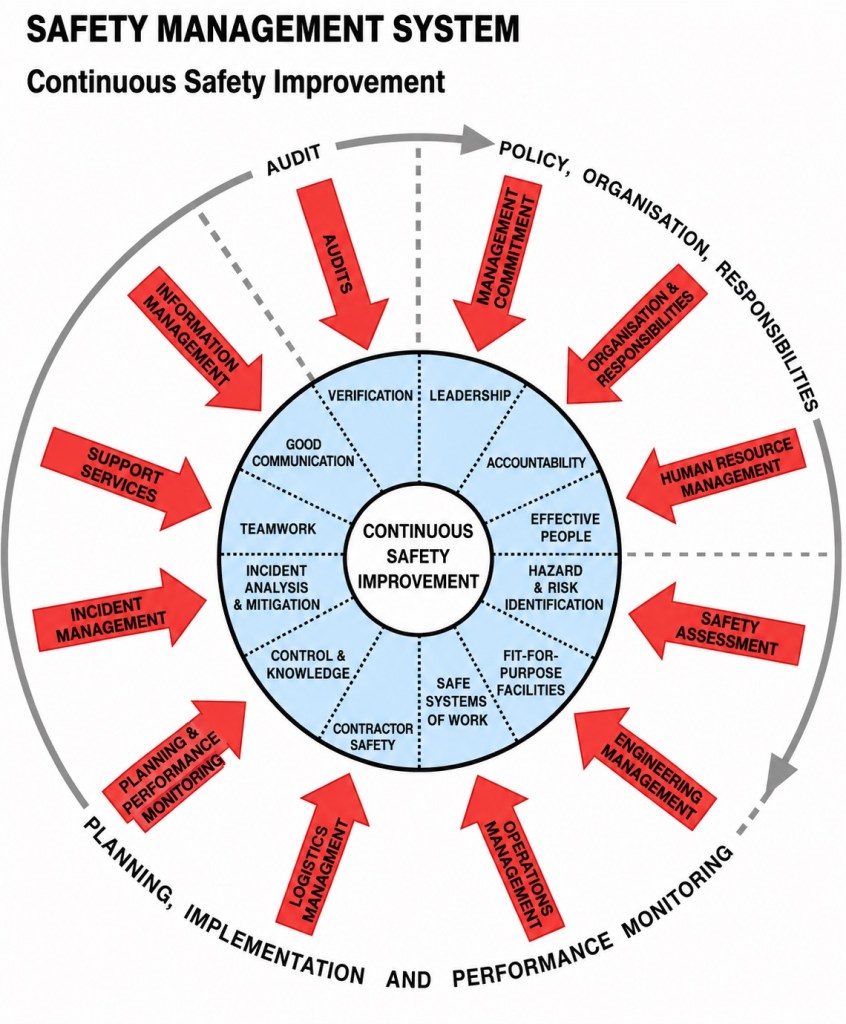
The target is to achieve continuous improvements to all aspects of the business from planning, design and production. 1% improvement a week will be 50% improvement in your SMS over a year.
UK Red arrows display team

Pull together as a team