
3.1 Boosting Health and safety communications

In every high-performing Environment and Health & Safety (EHS) system, communications is the glue and invisible thread that ties everything together—from leadership policy down to daily task execution. No matter how robust your procedures or how sophisticated your systems if communication fails, safety fails.
This page highlights why communication is not just a tool but a primary driver of EHS performance. It explores how to ensure that critical safety information reaches the people who need it—clearly, consistently, and in a format they can understand and act upon.
In Ontario, the Internal Responsibility System (IRS) places a clear duty on everyone in the workplace from workers to supervisors to managers to take ownership of health and safety. A critical part of this system is communications. When a hazard is identified and communicated to a supervisor, it becomes the supervisor’s responsibility to act. That responsibility continues up the management chain, ensuring accountability at every level.
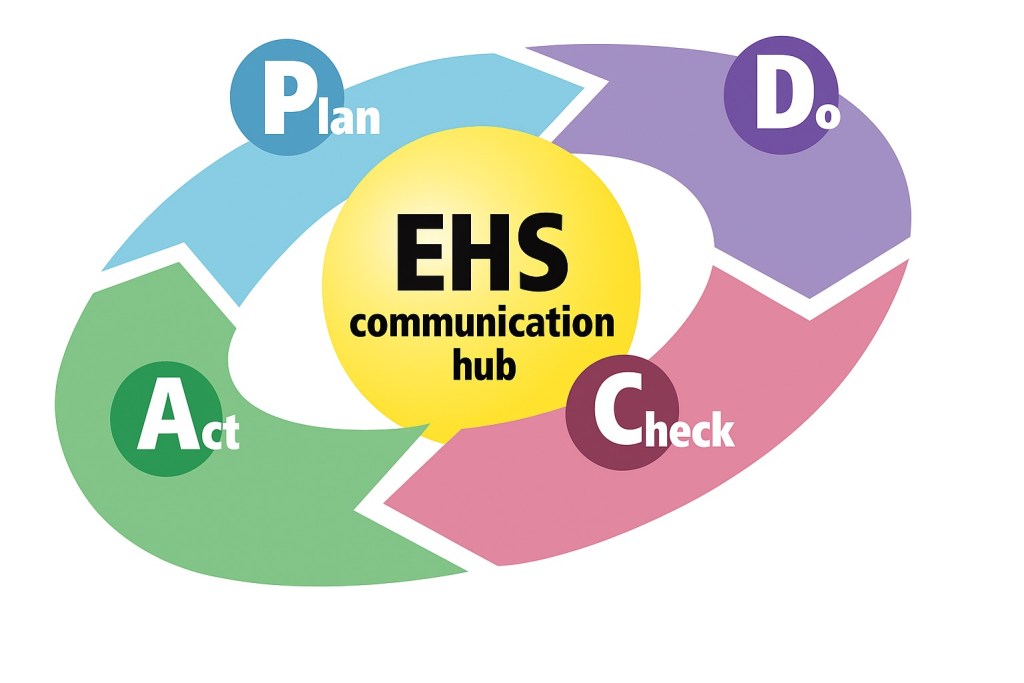
Whether you’re writing a procedure, delivering training, or guiding your team through a complex task, the effectiveness of your communication determines the success of your safety program. Have a upto date files and evolve a communication Hub central to your communication strategy.
Why Communication Matters in EHS
- Communication is the bridge between policy and action.
- Mis-communication is a leading factor in many incidents, from minor near-misses to major disasters.
- Good communication fosters trust—workers are more likely to engage with safety programs when they feel informed and heard.
- It’s a two-way street: listening to feedback is just as important as delivering
- Communications drive better Safety performance if given clearly
Example:– In the aftermath of the Piper Alpha disaster, poor communication especially around handovers and permit-to-work (PTW)was identified as the critical failure point in communications
How to Get Information to the User Effectively?
The challenge is how do we get the essential information to the user and make sure it is understood?
- Condense and simplify: Regulations and procedures are often long and technical; workers need task-specific, actionable guidance like check sheets and written procedures
- Use check sheets and quick-reference guides: These summarise the essentials into an easy-to-follow format.
- Visual aids: Diagrams, infographics, Zoning and signage are powerful tools, especially in multilingual or low-literacy environments.
- Layered communication: Use multiple channels (verbal, written, visual, digital, communication hub) to reinforce key safety messages.
- Technology-enhanced: Mobile apps and QR codes can provide instant access to full procedures or training videos when more detail is needed.
- Clear job descriptions with detailed responsibilities and competency requirements.
I recall when I was co-ordinating the safety Case for a Centrica offshore gas field we asked the operators to contribute towards reviewing operating procedures, their union objected saying there members could not do this so we simply included “Participation in reviewing operating Procedures’ In the job descriptions
Guiding Principle – Think of every safety communication as a micro-training opportunity—is the message clear, concise, and actionable?

The best ways to communicate safety
Often it is convenience to just send a email but you need to ensure the communication is received understood by;-
1 Face-to-Face Communication
- Most effective. Enables immediate clarification, shows commitment, and allows for observation of body language.
- Toolbox talks, briefings, and site walkthroughs are critical moments.
2 Visual Communication
- Posters, signs, and labels that are clear, simple, and strategically placed where the risk exists.
- Visual reminders boost retention and serve as a constant prompt.
3 Written Communication
- Policies, procedures, bulletins—formal documentation is essential but must be accessible (avoid jargon, keep it short where possible).
- Summarize key actions at the start of every document.
4 Digital & Mobile Communication
- Apps, emails, and text alerts are valuable for remote teams or dynamic work environments.
- Digital checklists and incident reporting tools can keep safety front-of-mind.
5 Peer-to-Peer & Team Debriefs
- Encouraging workers to communicate safety among themselves builds a strong safety culture.
- Peer checks (like buddy systems) can be life-saving.
SECTION 4: The Role of Supervisors and Management
- Supervisors are the communication linchpins—they translate policy into practice.
- Management’s visible commitment to communication (e.g., open-door policies, active listening) sets the tone for the whole organization.
- Regular review of communication effectiveness (e.g., through audits or feedback) ensures continuous improvement.
Conclussion
Communication is not an add-on—it is the core of your EHS program’s effectiveness. By prioritizing clear, concise, and task-relevant communication, you empower your teams to act safely and confidently. Remember: the best safety system in the world is only as good as your ability to communicate.

The authors father John J Bell developed the coloured smoke trails for the UK RAF Lightning 56 firebird aerobatic Squadron. 4 Typhoons with 7 Red Arrows fly past over Buckingham palace along the Royal Mall.