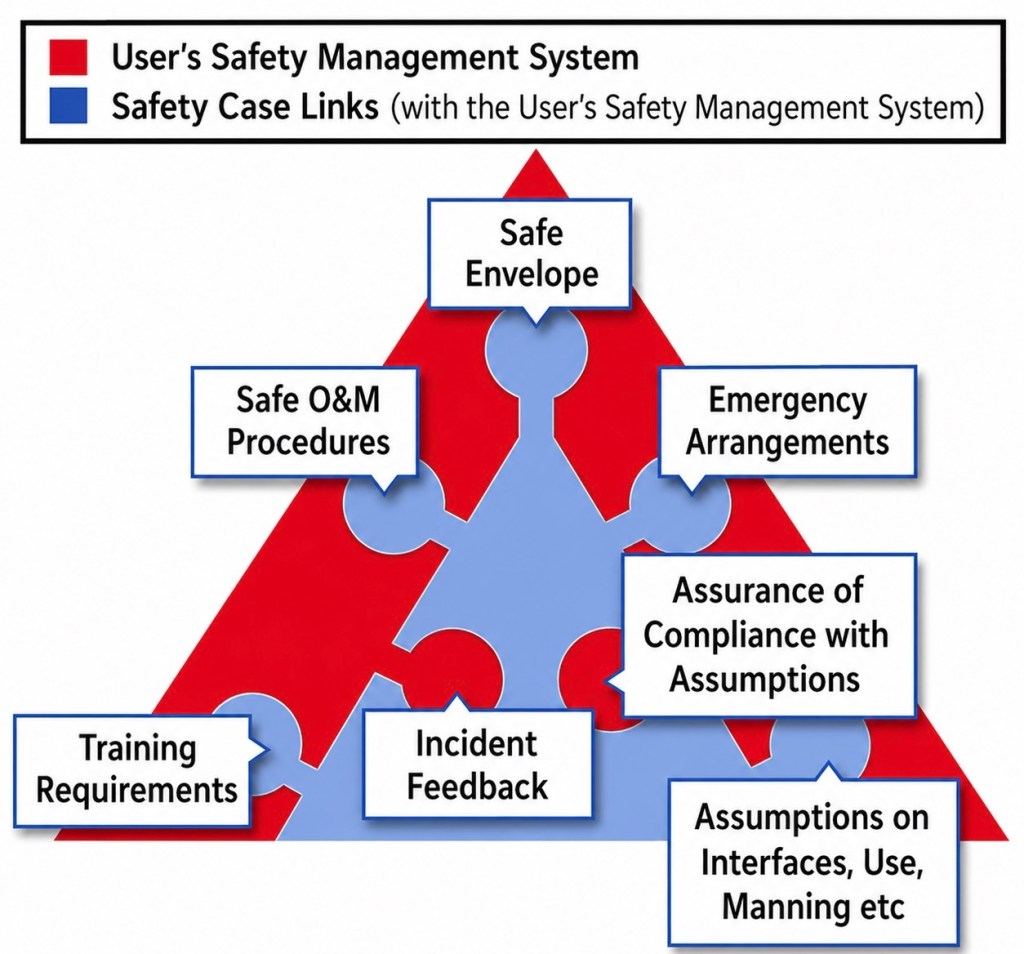

3.71 The “case for a safety case”
Are we doing the optimum or just the minimum? Safety Case approach spells out the Optimum
Steps towards achieving widespread adoption of the “Safety Case Methodology”

Regulations ask whether minimum legal requirements have been met. A Safety Case asks whether people, assets, the environment and the organisation are genuinely protected. AI now enables that question to be answered more thoroughly, more consistently and with greater evidence than ever before.
A Safety Case demonstrates that an organisation is fit for purpose—not merely compliant. It provides structured evidence that hazards have been identified, risks have been evaluated, controls have been verified and continuous improvement is taking place.
The Case for a Safety Case

Every major industrial disaster raises the same question: “Could this have been prevented?”
Traditional regulatory compliance asks a simple question:
Whether the incident involves an offshore platform, railway, aircraft, chemical plant, dam, warehouse, battery facility, high-rise building or natural hazard such as an earthquake, investigations almost always reveal that the hazards were already known. The failure was rarely a lack of knowledge – it was a failure to identify, evaluate and manage the consequences before the event occurred.
“Have we met the legal requirements?”
A Safety Case asks a far more important question:
“Have we done everything reasonably practicable to prevent foreseeable harm?”
That difference changes the entire mindset from reactive compliance to proactive risk management.
A Safety Case is not simply another document. It is a structured demonstration that an organisation understands its hazards, has assessed the potential consequences, has implemented effective barriers and controls and can demonstrate that it is genuinely “fit for purpose” and has exercised “Due diligence“.
The emergence of Artificial Intelligence now makes this approach more practical than ever before. AI can rapidly analyse previous incidents, identify similar hazards, review Safety Management Systems for weaknesses, highlight missing controls and support organisations in developing stronger, evidence-based Safety Cases.

This website promotes a simple philosophy:
Why only do what regulations require when you can do what is demonstrably safer?
The greatest opportunity for AI is not replacing people—it is helping people recognise opportunities for continuous improvement before accidents occur.
The future of health and safety will not be measured solely by compliance. It will be measured by an organisation’s ability to demonstrate that foreseeable risks have been identified, understood and effectively controlled. – That is the case for a Safety Case.
We must and can learn from previous incidents where a incident like a system failure can set off a cascading series of events as exampled in this section of “The Case for a safety Case”.
Safety Case methodology identifies how a facility is prepared and “fit for purpose” to manage EHS developing hazard scenario’s. By analyzing the causes of past incidents we can ensure hazards are identified and risks managed without consequences to health, property and the environment.

A “Safety Case” is a proactive process you can take to identify management omissions, human errors and the consequences arising from those omissions and the cascading effects of Hazards. An organizations Safety Case demonstrates how a facility is designed to plan and manage any EHS emergency scenario.

There is a common omission in all of these disasters – an absence of an up to date total Safety Case to identify the full effects of cascading hazards and the consequences of management omissions! All of these incidents could have been avoided with a comprehensive safety case
A Safety Case asks:
“What could catastrophically go wrong here — and how do we prove it is controlled?”
International Examples
A recent Explosion at a major LPG gas processing plant. Extra safeguards are required when a plant has been shut. down. OECD is also very useful. Its 2025 report says serious chemical accidents still occur despite existing legal frameworks, and it frames regulation as reducing consequences to people, the environment, and the economy. The OECD Guiding Principles also state that many chemical accidents could have been prevented if lessons from past accidents and basic process safety management had been properly implemented.

Libya Dam collapse – A safety case approach would have identified the effect on communities downstream of a dam failure and rush of water. A warning siren to warn of a flood would have been such a measure had it been maintained and sounded but anticipating the effects of global warming and strengthening the old dams should have been seen as a priority.

- Hotel fire at another ski resort in Turkey Over 65 dead and many injured. Would appear that there was not an adequate fire evacuation plan or an adequate fire water sprinkler system to extinguish the fire. A safety case would include emergency arrangements in case of a fire.

2. South Korean air crash asks the question how this can happen? solid concrete structures close to the end of the runway. It was also known that the airport was on a bird migratory route

3. Lithium Battery factory fire in South Korea – kills 22 workers some unrecognizable. This type of incident is happening to often and can effect all users. A Safety case would identify cascading hazards and ommissions in fire security

4. Baltimore Bridge Collapse – The Baltimore port Authorities Safety Case should have been updated to include the High tonnage of modern container ships to determine if the bridge protection was adequate to with stand the impact. If not additional preventive measures should have been deployed immediately for example escorting and towing large ships with powerful tug boats to keep them in the center of the channel until the necessary additional protection is installed.

6. Had the UK offshore safety case regulations been in place prior to the Piper Alpha disaster would not have been so consequential as a safety case would requires a complete assessment of all likely incident scenarios, emergency responses, hazards assessed and management control measures.
The UK offshore Safety Case regime followed the 1988 disaster, which killed 167 people, and required operators to demonstrate how they manage major accident hazards.

7. Grenfell Tower Cladding fire – Despite warning this aluminum plastic sandwich material was widely used – A safety case would have obviated this fire scenario.

8. Fukushima Daiichi 2011 nuclear power plant disaster in Japan – where the full effects of a earthquake and Tsunami where not fully incorporated into a safety case.

9. Deep Water Horizon – Would have been avoided with a separation of drilling and Production inspection expertise – The question asked is why are the Drilling supervisors (Company man) not signed onto the permit to work when they give the instructions!

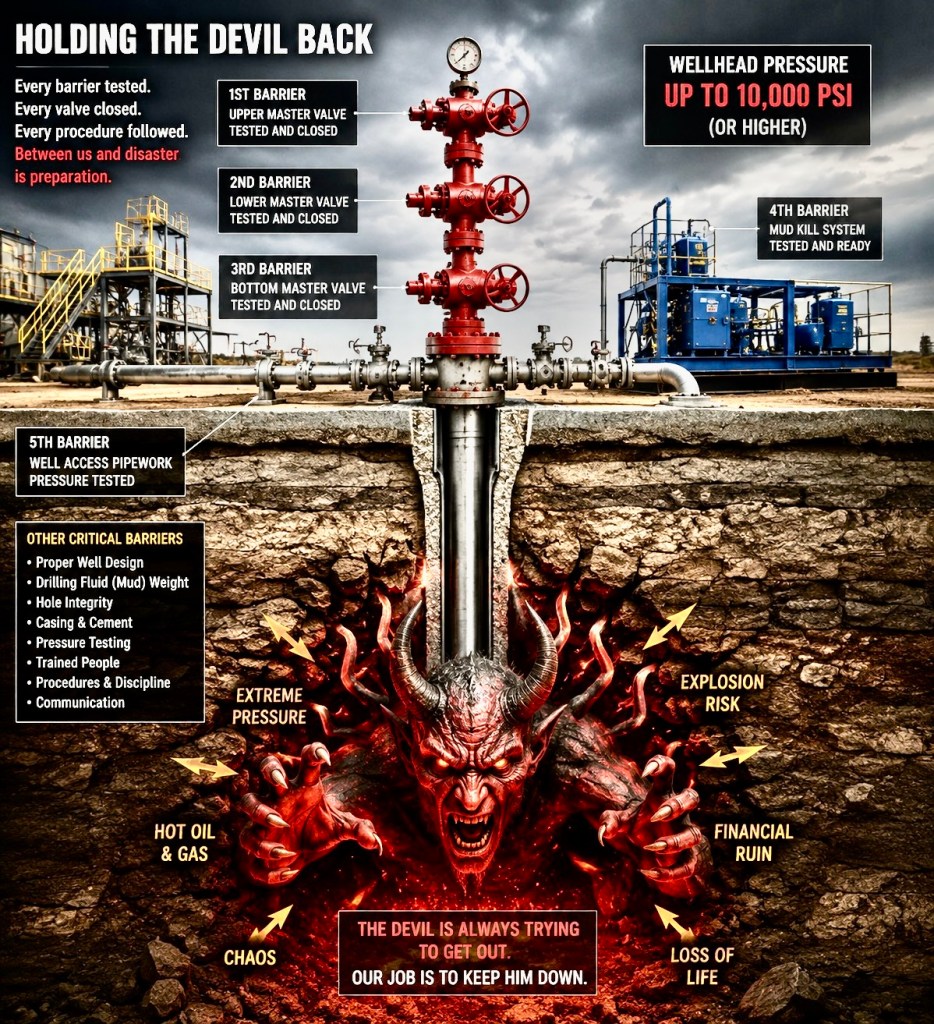
Safety Case to Hold the Devil back from coming to the surface
10. The Jim Beam Whiskey facility which was hit by lightning and 45,000 Aluminium barrels of whiskey were lost in 2019 is a good example where a safety case would have considered the consequences of a nearby lightning strike!

11. Ohio rail crash – A community in Ohio was exposed to hazardous chemicals which should have been prevented with better planning. We need to ensure the optimum and not the minimum (as dictated by regulations) for the management of Health and safety.

See the whole scenario before it happens not just surmising the small detail, see the total safety case. Take a holistic and detailed planning approach. Regulations need upgrading by talking to the experts to ensure that we have any chance of resolving major OHS and environmental issues and to regulate a safety case approach to understand the consequences of omissions
Appeal to World Leaders: The Critical Need for Safety Cases
In an era where technological advancements bring immense benefits, we must also acknowledge the growing complexity and risks associated with modern infrastructure and industries. Recent tragedies, such as the Fukushima nuclear disaster and the Libya dam burst, reveal a disturbing pattern of preventable failures that have resulted in catastrophic loss of life and environmental damage. These events are not isolated incidents; they are linked by a common thread— the absence of thorough, proactive safety planning and regulations.
A safety case methodology provides a structured approach to identifying, analyzing, and mitigating risks, ensuring that every potential hazard is considered and addressed. By mandating the use of safety cases, particularly in industries where public safety is at stake, we can prevent disasters before they occur. I urge you to take decisive action to make safety case methodologies a global standard. By doing so, we can save lives, protect communities, and build a safer future for all in this age of global warming and instability.
Concept for an International “Safety Case” Guidance Standard
Discussion paper for the Standards Council of Canada ISO TC 283 and IOSH – Prepared by Timothy Bell
Purpose and recommendation
Recommendation. Open an exploratory standards discussion on international guidance for developing, maintaining and reviewing an organizational Safety Case.
The guidance would complement ISO 45001 by helping an organization assemble and test the evidence that its significant hazards are understood and its controls are suitable, sufficient and effective.
The gap the proposal addresses
Regulations and ISO 45001 establish essential duties and management-system expectations. They do not, by themselves, consolidate the organization-specific argument and evidence showing that a particular operation is fit for purpose. Information can remain divided among risk assessments, procedures, engineering records, permits, contractor files, emergency plans, audits and lessons learned. Important connections, omissions and cascading consequences can therefore be missed.
A Safety Case places ownership with the organization that creates and controls the risk. Compliance remains essential, but it is the minimum starting point. The organization should also be able to demonstrate why its arrangements protect workers, the public, property and the environment under normal, abnormal and changing conditions.
Proposed definition
An organizational Safety Case is a structured, evidence-based demonstration that significant hazards have been identified; credible consequences and escalation pathways have been examined; controls and barriers are appropriate and verified; responsibilities are understood; and the case is reviewed as operations, knowledge and conditions change
page 1 of 4
Relationship with ISO 45001
| ISO 45001 management system | Complementary Safety Case guidance |
| Defines the framework for managing OH&S risks | Demonstrates how the framework controls the organization’s actual hazards |
| Requires leadership accountability and worker participation | Shows responsibilities, competence, communication and assurance in practice |
| Uses planning, operation, checking and continual improvement | Connects claims, evidence, performance findings and updates in a living record |
| Requires legal and regulatory compliance | Goes beyond minimum compliance to demonstrate suitability and fitness for purpose |
Proposed scope
The guidance should be scalable for small and medium-sized organizations as well as major-hazard industries. It should be usable voluntarily, contractually, by insurers and investors, or by regulators through reference in policy or legislation. It should address occupational, process, infrastructure and public-safety consequences without displacing sector-specific requirements.
Core contents of a Safety Case
- Purpose, scope, boundaries, operating context and responsible leadership.
- Applicable legislation, standards, licence conditions and stakeholder expectations.
- Description of activities, assets, interfaces, contractors and safety-critical roles.
- Hazard identification, human and organizational factors, credible consequences and cascading scenarios.
- Risk evaluation, including the basis for judging controls proportionate and risks reduced so far as reasonably practicable where applicable.
- Preventive, protective, mitigating and recovery barriers, with performance standards and evidence of verification. Page 2 of 4
- Operating procedures, permits, check sheets, competence, supervision and communications.
- Emergency preparedness, response, recovery and coordination with external parties.
- Assurance evidence from inspection, maintenance, monitoring, audits, incidents, near misses and lessons learned.
- Management of change, drift, climate and environmental conditions, new technology and emerging hazards.
- A review and update cycle that keeps the Safety Case current, accessible and communicated.
Value to stakeholders
| Stakeholder | Practical value |
| Organizations | Clear ownership of risk; better decisions; fewer gaps between departments and contractors; demonstrable due diligence; stronger resilience and continual improvement. |
| Workers and public | Greater confidence that hazards, human factors, escalation pathways and emergency arrangements have been examined together. |
| Insurers and investors | A consistent evidence base for understanding risk quality, governance, critical controls and improvement commitments; potential support for proportionate terms and oversight. |
| Regulators | A standard structure for reviewing whether the organization understands and controls its risks, while preserving regulatory authority and independent inspection. |
| Supply chains | Clearer assurance requirements across clients, designers, contractors, operators and maintainers. Page 3 of 4 |
Why this is practical now
Historically, the time and specialist effort required to gather and maintain a Safety Case limited wider adoption. AI can reduce this burden when used under competent human oversight. It can help classify records, compare incidents, connect hazards with consequences and barriers, identify omissions, monitor changes, support communication and retrieve relevant lessons from worldwide experience. AI does not own the risk or approve the Safety Case; accountable leaders and competent specialists must validate the evidence and decisions.
This creates the opportunity for a living Safety Case rather than a static document: Incident or change → lesson learned → knowledge added → AI-assisted review → better barrier → updated Safety Case → safer design and operation.
Suggested ISO pathway and first discussion
The initial objective is to test international need, scope and committee ownership. ISO/TC 283 is a natural starting point because it is responsible for occupational health and safety management and ISO 45001. Liaison with ISO/TC 262 on risk management and relevant sector committees may be needed because major-accident consequences extend beyond occupational safety.
A guidance document may be a more appropriate first deliverable than a new certifiable requirements standard.
Questions for stakeholders. Is there a recurring assurance gap? Would common terminology and minimum content improve decisions? Can the guidance scale across sectors and organization sizes? Which parties should participate in a preliminary study or workshop?
page 4 of 4
Letter to IOSH Policy and Standards team
11 September 2026
Policy and Standards Team
Institution of Occupational Safety and Health
United Kingdom
Subject: IOSH support for an exploratory ISO discussion on “Safety Case” guidance
Dear IOSH Policy and Standards Team,
As a Chartered Member of IOSH, I am seeking IOSH’s advice on opening an exploratory international standards discussion about guidance for organizational Safety Cases. IOSH’s liaison relationship with ISO/TC 283 makes its professional perspective particularly valuable.
My proposal is not to replace ISO 45001 or create an immediate additional certification burden. It is to consider guidance that would help an organization demonstrate, through connected and current evidence, that it understands its significant hazards and that its controls are suitable, sufficient and effective. Compliance would remain essential, but the Safety Case would address the further question: how does this organization know that people and other exposed parties are actually protected?
The attached concept paper draws on more than 45 years of health and safety and engineering experience, including offshore Safety Case work following Piper Alpha. It proposes scalable contents covering hazards, human factors, credible and cascading consequences, critical barriers, contractor interfaces, emergency response, assurance, management of change and continual improvement.
The approach may be increasingly practical for a wider range of organizations because AI can assist competent professionals with organizing evidence, finding gaps, comparing worldwide incident experience and keeping a Safety Case current. AI would support the process; it would not replace professional judgement, worker participation, leadership accountability or independent assurance.
I would appreciate IOSH’s view on three questions: whether the need merits preliminary study; whether ISO/TC 283 is the appropriate starting point; and whether IOSH might help convene or participate in an initial discussion involving standards, industry, regulators, workers and insurers.
Letter page 1 of 2
Supporting explanatory material is available at https://boostingwithai.com/boosting-your-safety-case-with-ai/the-casefor-a-safety-case/ including the flipbook “The Case for a Safety Case”.
I would welcome the opportunity to discuss the proposal and refine it in light of IOSH’s standards experience.
Yours sincerely,
Timothy Bell

B.sc (hons), HSPC (number 1003633 retired), Chartered IOSH member (number 020132 – Retired) and Euro Chartered Eng. – Submitted 14 September 2026
Unit 309 – 379 Scott Street. St Catharines
Ontario. Canada. L2M 0B7
email – timotheybell5@gmail.com
tel. – Can 905 933-0230
A concise visual statement of the strategy being actively followed.
“Safety cases provide the ‘big picture’ visibility that day-to-day risk assessments often miss. They are a strategic lens through which we can anticipate and eliminate consequences—not just mitigate them.”
“Eight Challenges to Safety Case Adoption — and the Safeguards.”
| Challenge | Safeguard |
|---|
| 1. No regulatory requirement | Encourage voluntary adoption through industry, insurers and professional bodies while standards and regulatory options are considered. A Safety Case can add value independently of whether legislation requires one. |
| 2. Cost and resources | Use a proportionate approach based on the scale and severity of the hazards. AI can assist with research, historical incident searches, information organization and updating, while competent people retain responsibility for safety decisions. |
| 3. Duplication of existing systems | Build upon existing risk assessments, ISO 45001, HAZOP, bow-ties, audits and regulatory compliance rather than replacing them. The Safety Case brings this evidence together into a coherent demonstration that risks are adequately controlled. |
| 4. Becoming another document on the shelf | Require a Living Safety Case, reviewed when equipment, processes, personnel, technology, operating conditions or external knowledge changes—and following incidents and near misses. |
| 5. Competence and consistency | Establish a common framework, guidance and competency requirements. Standardize the Safety Case structure while allowing the technical content to reflect the hazards of each industry and organization. |
| 6. Self-assessment and false confidence | Require evidence rather than assertion. Critical barriers should be tested and verified, assumptions challenged, weaknesses recorded and appropriate independent scrutiny provided by specialists, insurers and regulators. |
| 7. AI reliability and accountability | AI should assist—not make—the safety decision. AI-generated findings must be traceable to reliable sources and reviewed by competent people. Responsibility remains with the organization and accountable decision-makers. |
| 8. Regulatory and industry resistance to change | Introduce the methodology progressively through voluntary guidance, pilot projects, insurers and industry sectors. Regulators can then evaluate whether Safety Cases improve risk visibility and enable more focused, risk-based oversight before wider adoption is considered. |
Proposed Comprehensive Safety Case Index
A practical guide, prompt and memory jogger for every employee
My experience as a Safety Case Coordinator highlights something important: the Safety Case index is not simply a table of contents. It can become one of the most effective tools for communicating, managing and continuously improving safety across an organization.
Index available to all staff. A well-designed index can encourage employees to ask questions, understand their responsibilities, identify weaknesses and contribute to improvements.
The objective should be:
Every employee should be able to find out what could go wrong, what prevents it, what their responsibilities are, and what to do when something is wrong.
Recommended Safety Case Index
Suggest 12 principal sections, with numbered subsections. This retains the simplicity of your original proposal while making the index more comprehensive.
1. Company Context, Purpose and Priorities
1.1 Company profile, activities and services
1.2 Business objectives and strategic priorities
1.3 Operating locations, facilities and boundaries
1.4 Stakeholders, employees, contractors and the public
1.5 Business risks, opportunities and future changes
1.6 Purpose, scope and limitations of the Safety Case
Memory jogger: Do we understand our business and the people who could be affected by our activities?
2. Leadership, Policies and Safety Commitments
2.1 Corporate health and safety policy
2.2 Leadership commitments and safety messages
2.3 Safety objectives and performance standards
2.4 Safety culture and employee participation
2.5 Due diligence and accountability
2.6 Continuous improvement commitments
Memory jogger: Are our policies reflected in what actually happens at work?
3. Organization, Responsibilities and Competence
3.1 Organizational structure and reporting relationships
3.2 Responsibilities by department
3.3 Job descriptions and safety-critical duties
3.4 Competence, qualifications and training requirements
3.5 Contractor selection, responsibilities and supervision
3.6 Induction, refresher training and competency verification
3.7 Authority to stop unsafe work
3.8 Succession planning and transfer of knowledge
Memory jogger: Does everyone know what they are responsible for, and are they competent to perform those duties?
4. Legal, Regulatory and Insurance Requirements
4.1 Applicable legislation and regulations
4.2 Permits, licences and operating approvals
4.3 Relevant standards and industry guidance
4.4 Regulatory inspections and correspondence
4.5 Insurance policies, coverage and exclusions
4.6 Insurer recommendations and risk improvement requirements
4.7 Compliance verification and legal obligations
Memory jogger: Can we demonstrate compliance and explain why our arrangements are fit for purpose beyond minimum compliance?
5. Hazard Identification and Risk Assessment
5.1 Hazard identification procedures
5.2 Hazard register and risk assessments
5.3 Major accident hazards and credible worst-case scenarios
5.4 Cascading hazards and escalation pathways
5.5 Simultaneous operations and interactions between activities
5.6 Human factors and foreseeable human error
5.7 Environmental and external hazards
5.8 Emerging hazards and changing technologies
5.9 Assessment of risk tolerability and uncertainty
Memory jogger: Have we considered not just what could go wrong, but what else could fail as a consequence?
6. Prevention, Protection and Safety Barriers
6.1 Hierarchy of risk controls
6.2 Engineering and design safeguards
6.3 Operating procedures and safe systems of work
6.4 Permit-to-work and isolation arrangements
6.5 Safety-critical equipment and systems
6.6 Preventive maintenance, inspection and testing
6.7 Barrier ownership and performance standards
6.8 Barrier failures, impairments and compensating measures
6.9 Independent verification and assurance
Memory jogger: What prevents a major accident, and what evidence shows that those barriers will work when needed?
7. Operational Control, Inspection and Monitoring
7.1 Routine operating controls
7.2 Workplace safety inspections
7.3 Equipment and asset integrity inspections
7.4 Monitoring of safety-critical activities
7.5 Occupational health and exposure monitoring
7.6 Housekeeping and workplace conditions
7.7 Corrective actions and close-out verification
7.8 Management of non-routine activities
Memory jogger: Are we checking the right things frequently enough, and do we act on what inspections reveal?
8. Emergency Preparedness and Response
8.1 Credible emergency scenarios
8.2 Emergency response plans and responsibilities
8.3 Evacuation, rescue and shelter arrangements
8.4 Fire, medical and environmental emergencies
8.5 Communication with emergency services and the public
8.6 Emergency equipment, testing and maintenance
8.7 Emergency drills and exercises
8.8 Recovery and business continuity
Memory jogger: If our preventive measures fail, can we protect people and limit the consequences?
9. Reporting, Investigation and Learning
9.1 Hazard and unsafe condition reporting
9.2 Near-miss and incident reporting
9.3 Accident and major incident investigation
9.4 Root cause and systemic failure analysis
9.5 Reporting to regulators and insurers
9.6 Lessons learned and communication to employees
9.7 Corrective and preventive actions
9.8 Verification that improvements are effective
Memory jogger: Are we learning from warning signs before they become serious accidents?
10. Change Management and Future Risks
10.1 Management of technical changes
10.2 Organizational and personnel changes
10.3 New equipment, materials and technologies
10.4 Contractor and supplier changes
10.5 Temporary operating arrangements
10.6 Ageing infrastructure and equipment deterioration
10.7 Changing legislation and industry expectations
10.8 Pre-startup safety reviews and change authorization
Memory jogger: Could a change introduce new hazards or invalidate existing safety assumptions?
11. Performance, Audit and Continuous Improvement
11.1 Safety performance indicators
11.2 Leading and lagging indicators
11.3 Internal audits and independent reviews
11.4 Management reviews and leadership inspections
11.5 Employee and contractor feedback
11.6 Benchmarking and industry lessons
11.7 Improvement plans, priorities and resources
11.8 AI-assisted analysis and identification of opportunities
Memory jogger: How do we know safety performance is improving rather than simply remaining compliant?
12. Safety Case Evidence, Accessibility and Governance
12.1 Safety Case summary and demonstration of fitness for purpose
12.2 Supporting studies, calculations and technical reports
12.3 Hazard-to-barrier-to-evidence traceability
12.4 Document register and controlled references
12.5 Document ownership, review dates and revision history
12.6 Employee access, search and navigation
12.7 Staff suggestions, questions and feedback
12.8 Safety Case review, approval and periodic revision
12.9 Outstanding assumptions, gaps and improvement commitments
Memory jogger: Can an employee quickly find reliable, current evidence supporting a safety decision?
Mr Bells Father invented the Coloured smoke trails for RAF Lightning display team

Head for the line