
3.7 Boosting your safety case with AI
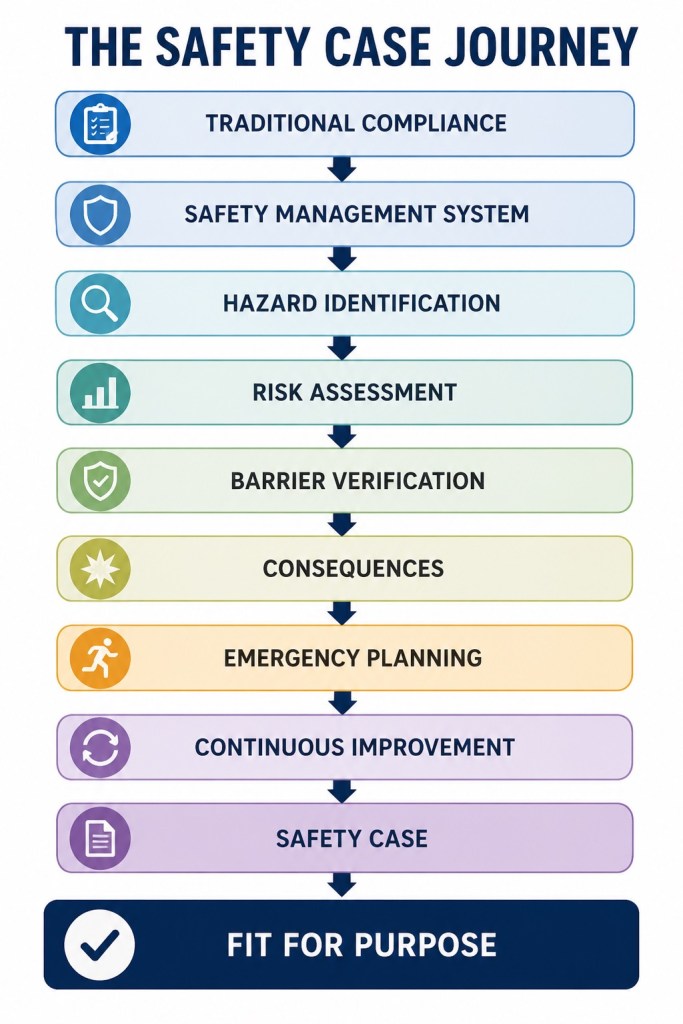
A Safety Case demonstrates that an organisation is fit for purpose – not merely compliant. It provides structured evidence that hazards have been identified, risks have been evaluated, controls have been verified and continuous improvement is taking place.
What is a Safety Case?
Flip Book Summary URL – https://boostingwithai.com/books/safety-case-1a/
It introduces the concept, explains cascading hazards, discusses due diligence and continuous improvement, and positions the Safety Case above simple compliance.
Regulations ask whether minimum legal requirements have been met. A Safety Case asks whether people, assets, the environment and the organisation are genuinely protected. AI now enables that question to be answered more thoroughly, more consistently and with greater evidence than ever before.
A safety case is a methodology used by organizations to protect Brand, assets, people and the environment. This website uses the safety case methodology to benefit all organizations large and small by identifying omissions and their consequences in their SMS and hazards that can cascade out of control – a Knock on effect. For example with a lithium battery fire, a single battery fire can result in the loss lives and the facility.
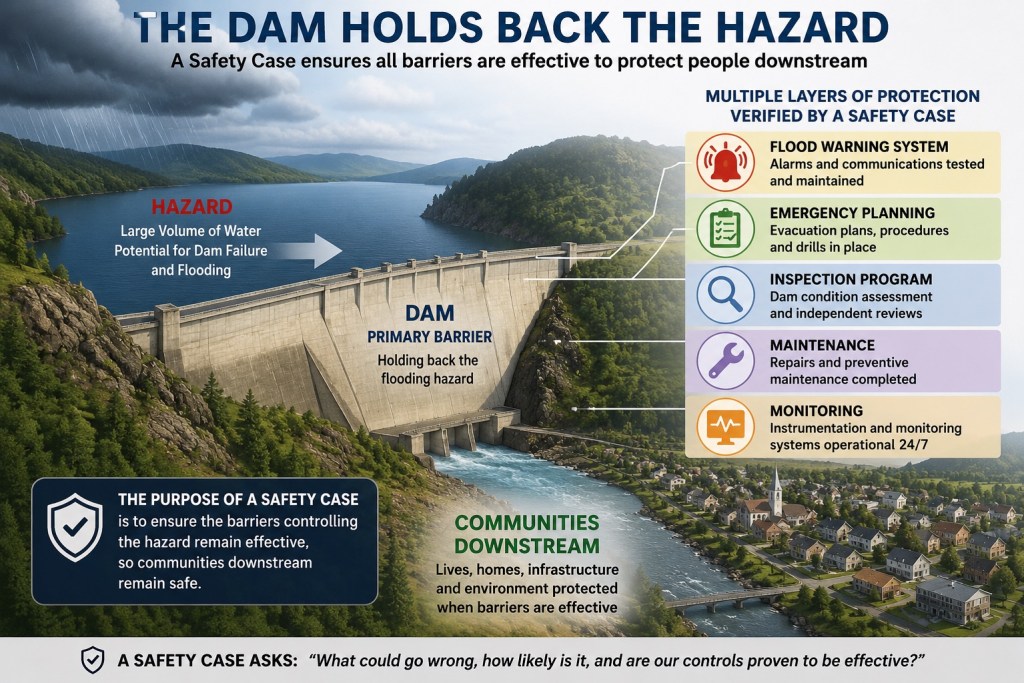
In an increasingly regulated and complex operating environment, incidents often begin with small hazards that escalate and cascade into catastrophic failures. These incidents can be prevented with a clear understanding of risks, human factors, and external influences, all laid out in a well-structured safety case.

Why a Safety Case?
A safety case looks at the completeness of your SMS for omissions, Human errors, identifies hazards, their cascading effects, and the controls needed to prevent incidents.Ensures Controls for safe working are appropiate and understood.
“Due diligence” requires demonstrating that your organization is “Fit for purpose”. A Safety Case provides that demonstration.
Whether it’s Lithium Batteries or a hovercraft service operating across Lake Ontario, every type of organization can benefits from a detailing a safety case. Although not a regulative requirement developing a safety case has these advantages.
- Look at previous incidents, their causes and how to prevent a similar incident
- Evaluate your SMS for completeness and omissions.
- Identify Cascading Hazard Analysis: Small hazards that may seem insignificant on their own are analyzed for their potential to cascade and escalate into a major incident.
- Have a Holistic Perspective: External factors like weather, human errors, and infrastructure weaknesses are considered to give you the full picture.
- Give Practical Solutions: The safety case is presented in a simple format, typically 1-2 pages, making it clear, actionable, and easy to implement.
- Find Custom Fits: Whether you’re running a high-tech facility, a public service, or a small business, our AI-driven process tailors safety cases to your unique operations.

Why Safety Cases are the future of EHS
Traditional compliance systems focus on meeting minimum legal requirements. A Safety Case goes further by demonstrating that hazards have been identified, risks assessed, controls implemented and their effectiveness verified.
A Safety Case provides evidence that an organization is:
- Managing risks proactively
- Exercising due diligence
- Continually improving
- Fit for purpose
As workplaces become more complex and public expectations increase, organizations will increasingly be expected to demonstrate not only compliance but also that their operations are safe, reliable and responsibly managed.
The future of health and safety is not simply following regulations. It is demonstrating that risks are understood and effectively controlled.
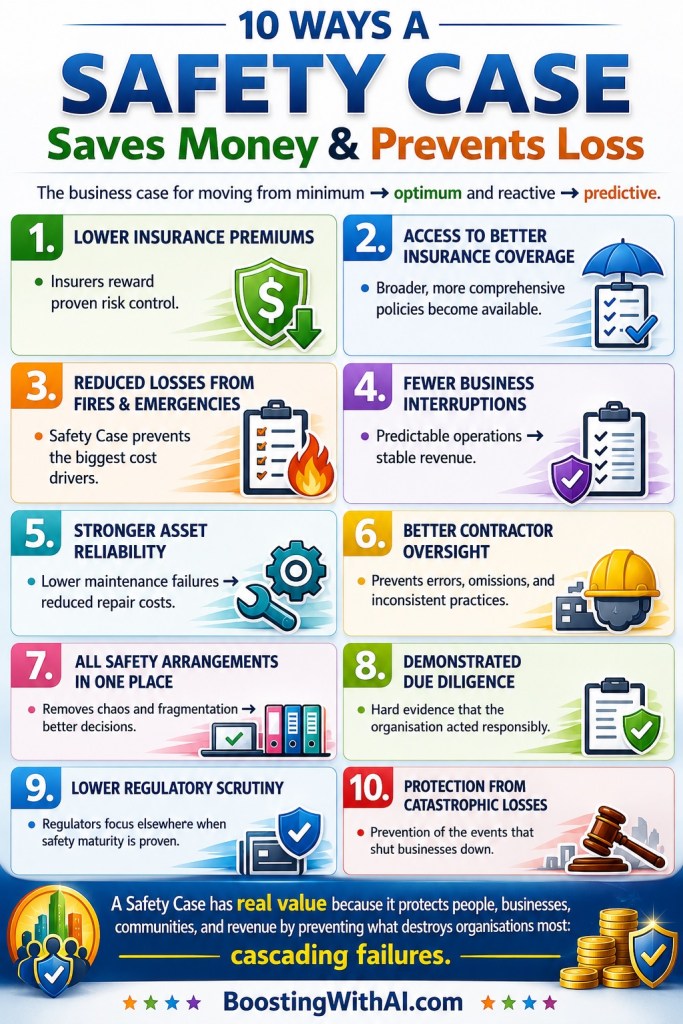
AI Changes the Economics of a Safety Case
Organizations already generate the information needed to understand and control their EHS risks. Historically, reviewing and maintaining this evidence required substantial manual effort, making a comprehensive, continuously updated Safety Case appear costly.
AI changes that calculation. It can rapidly connect incident history, near misses, inspections, maintenance, audits, procedures, environmental information and operational data. It helps competent professionals detect patterns, identify omissions, monitor barriers and keep the Safety Case current.
The result is not merely a less expensive document. It is a more efficient management system that reduces duplication, supports earlier intervention, improves reliability and demonstrates that the organization remains fit for purpose.
The question is no longer: “Can we afford to maintain a comprehensive Safety Case?” It is now : “Can we afford to operate without one?”

AI changes the economics
Historically, maintaining an up-to-date Safety Case required considerable engineering effort.
Large organizations often possessed thousands of:
- inspection reports;
- maintenance records;
- procedures;
- drawings;
- audits;
- incident investigations;
- operating manuals.
Reviewing all of this information manually was expensive and time consuming.
AI now allows much of this information to be reviewed continuously.
Rather than replacing competent engineers, AI enables them to focus on decision-making rather than searching for information.
This significantly improves the cost-effectiveness of maintaining a comprehensive Safety Case.
Continuous learning
Every organization generates valuable knowledge through:
- incidents;
- near misses;
- inspections;
- maintenance;
- modifications;
- audits;
- emergency exercises.
Unfortunately, much of this knowledge remains isolated within departments or individual sites.
AI enables organizations to convert historical information into future improvements.
Each lesson learned becomes an investment rather than a forgotten report.
Regulatory efficiency
Regulators cannot inspect every activity continuously.
A comprehensive Safety Case shifts the emphasis from:
“Have you complied?”
towards
“Can you demonstrate that your operation is fit for purpose?”
AI strengthens this demonstration by ensuring evidence remains current and lessons continue to be incorporated.
A new business philosophy
The question should no longer be:
“What does a Safety Case cost?”
The better question is:
“What is the financial cost of operating without one?”
When viewed this way, a comprehensive AI-supported Safety Case becomes an investment in:
- operational excellence,
- business resilience,
- environmental stewardship,
- workforce wellbeing,
- long-term profitability.
UK Red Arrows

Teamwork